
Johnson County Kentucky Genealogy
Johnson County sits in the beautiful mountains of eastern Kentucky, offering researchers a rich repository of genealogical records dating back to 1843. The county seat, Paintsville, serves as the central hub for family history research in this Appalachian region. Established from portions of Floyd, Lawrence, and Morgan counties, Johnson County holds unique genealogical treasures for those tracing their Eastern Kentucky heritage. The county's commitment to record preservation makes it an excellent resource for genealogists investigating their family roots in the Appalachian region.
Johnson County Quick Facts
Johnson County History for Genealogy
Johnson County emerged from the rugged Appalachian Mountains in 1843, carved from portions of three existing counties to better serve the growing population of eastern Kentucky. The county took its name from Richard Mentor Johnson, a Kentucky native who served as Vice President of the United States under President Martin Van Buren. This historical connection gives Johnson County genealogy researchers a unique tie to early American political history.
The county seat of Paintsville developed along Paint Creek, named for the colorful clay deposits found in the area that Native Americans reportedly used for body paint. This geographic feature played a significant role in the settlement patterns that genealogists must understand when tracing family movements in the region. Early settlers arrived from Virginia and North Carolina, bringing with them Scotch-Irish and German traditions that shaped the local culture.
For Johnson County genealogy researchers, understanding the parent county relationship proves essential. Before 1843, families in this area appeared in records from Floyd County (north), Lawrence County (west), or Morgan County (east). Researchers must check these parent counties for any records dating before Johnson County's formation, particularly land transactions, marriages, and court cases involving early settlers.
The mountainous terrain of Johnson County influenced settlement patterns significantly. Families often clustered in isolated hollows and valleys, developing tight-knit communities that maintained strong cultural traditions. These settlement patterns mean that Johnson County genealogy researchers often find that neighboring families intermarried extensively, creating complex kinship networks that span multiple generations.
Johnson County Clerk Genealogy Records
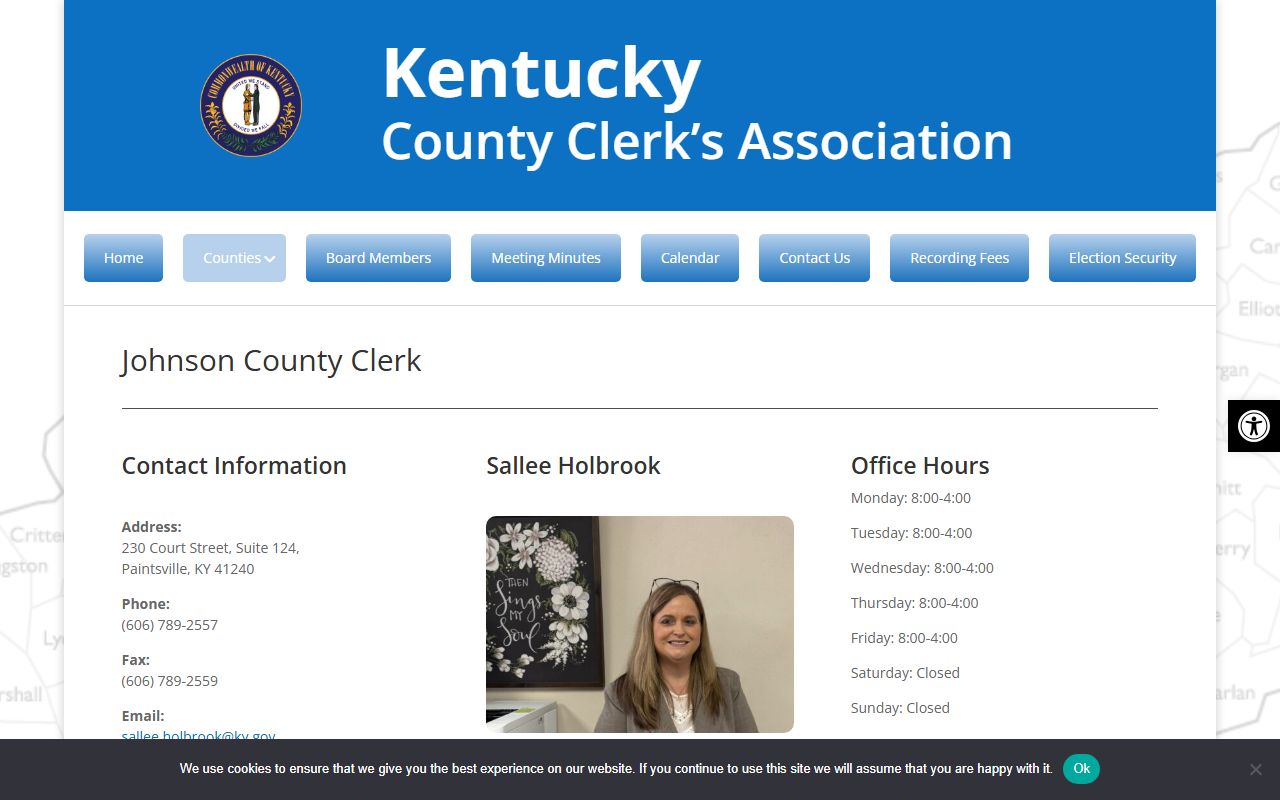
The Johnson County Clerk serves as the primary custodian of local records essential for family history research. The office maintains comprehensive records dating back to the county's founding in 1843, providing Johnson County genealogy researchers with access to land records, marriage licenses, court documents, and other vital legal filings. These preserved documents form the cornerstone of genealogical research in this Appalachian county.
The Clerk's office holds several essential record categories for tracing family lines:
- Deeds and land transfers from 1843 to present
- Mortgage records and property liens
- Marriage licenses and bonds
- Court case files and legal judgments
- Will records and estate settlements
- Voter registration records
- Notary commissions and oaths
| Office | Johnson County Clerk |
|---|---|
| Address |
230 Court St., Room 124 Paintsville, KY 41240 |
| Phone | (606) 789-2557 |
| Fax | (606) 789-2559 |
| Hours | Monday through Friday, 8:00 AM to 4:30 PM |
| Website | johnson.countyclerk.us |
The Johnson County Clerk emphasizes that all public records are available for viewing free of charge, making this an accessible resource for genealogy researchers on any budget. Staff members can assist with locating specific records, though they cannot conduct extensive research on behalf of visitors. Researchers should call ahead to verify hours and confirm the availability of specific record sets before making the trip to Paintsville.
Vital Records for Johnson County Genealogy
Vital records form the foundation of genealogy research in Johnson County. Understanding where to find birth, death, and marriage records can significantly advance your family history research. Johnson County genealogy researchers have multiple avenues for accessing these essential documents.
Birth and Death Records
Kentucky began statewide birth and death registration in 1852, though compliance remained inconsistent until 1911. For Johnson County births and deaths before 1911, researchers must rely on alternative sources such as Bible records, church registers, cemetery inscriptions, and delayed birth certificates. Many families in this Appalachian region maintained detailed family Bibles that serve as primary sources for early births and deaths.
The Kentucky Office of Vital Statistics maintains birth and death records from 1911 to present. Certificates can be ordered online, by mail, or in person at the Frankfort office. Birth certificates become public after 100 years, while death records become public after 50 years. Current fees are $10 for birth certificates and $6 for death certificates.
Marriage Records
Marriage records in Johnson County date back to 1843, the year of the county's formation. The County Clerk maintains marriage licenses and bonds, often the most accessible vital records for genealogy research. Early marriage records typically include the names of the bride and groom, the date of marriage, and the officiant. Some records may list parents or bondsmen who provided financial security for the marriage, offering valuable relationship clues.
Johnson County Land Records Research
Land records provide some of the most detailed glimpses into ancestral lives in Johnson County. Deed books trace property ownership from the pioneer era through modern transactions, revealing relationships, economic status, and migration patterns that vital records cannot capture. For Johnson County genealogy researchers, these documents are indispensable.
Johnson County deeds typically contain the names of grantor and grantee, the purchase price, land description, and the date of transfer. Witnesses and neighbors mentioned in deeds may be relatives or close associates. Early land records use metes and bounds descriptions referencing natural features like trees, creeks, and rock formations common in the Appalachian terrain.
Researchers must remember that land might have been purchased while the area was still part of Floyd, Lawrence, or Morgan counties. Records before 1843 require checking the parent county clerk's offices. Many early settlers obtained land through military warrants or homestead claims, creating additional paper trails for genealogists to follow.
The mountainous landscape of Johnson County meant that land ownership was particularly significant for early settlers. Steep terrain and limited flat land made property boundaries especially important. Disputes over property lines often generated court records that provide unexpected family details for genealogy researchers.
Wills and Court Records for Genealogy
Court records illuminate the daily lives and disputes of Johnson County ancestors. The Circuit Court handled civil cases, criminal prosecutions, and estate administration. Will books record the final wishes of the deceased and often name spouses, children, and other relatives. For Johnson County genealogy researchers, these documents provide crucial relationship evidence.
Probate packets contain the complete estate file including the original will, inventory of property, sale bills, and distribution records. These documents reveal family relationships, economic standing, and community connections. In Johnson County, where families often lived in isolated communities, estate records frequently show interdependence among neighbors and extended family members.
Civil court cases involving debts, property disputes, or other matters provide unexpected family details. Plaintiffs and defendants often called neighbors and relatives as witnesses. Depositions taken before trial can contain biographical information unavailable elsewhere. Johnson County genealogy researchers should examine both circuit court records and quarterly court sessions.
Johnson County Online Genealogy Resources
The internet has transformed genealogy research, bringing distant records to home computers. Several websites offer Johnson County-specific resources alongside broader Kentucky and national databases.
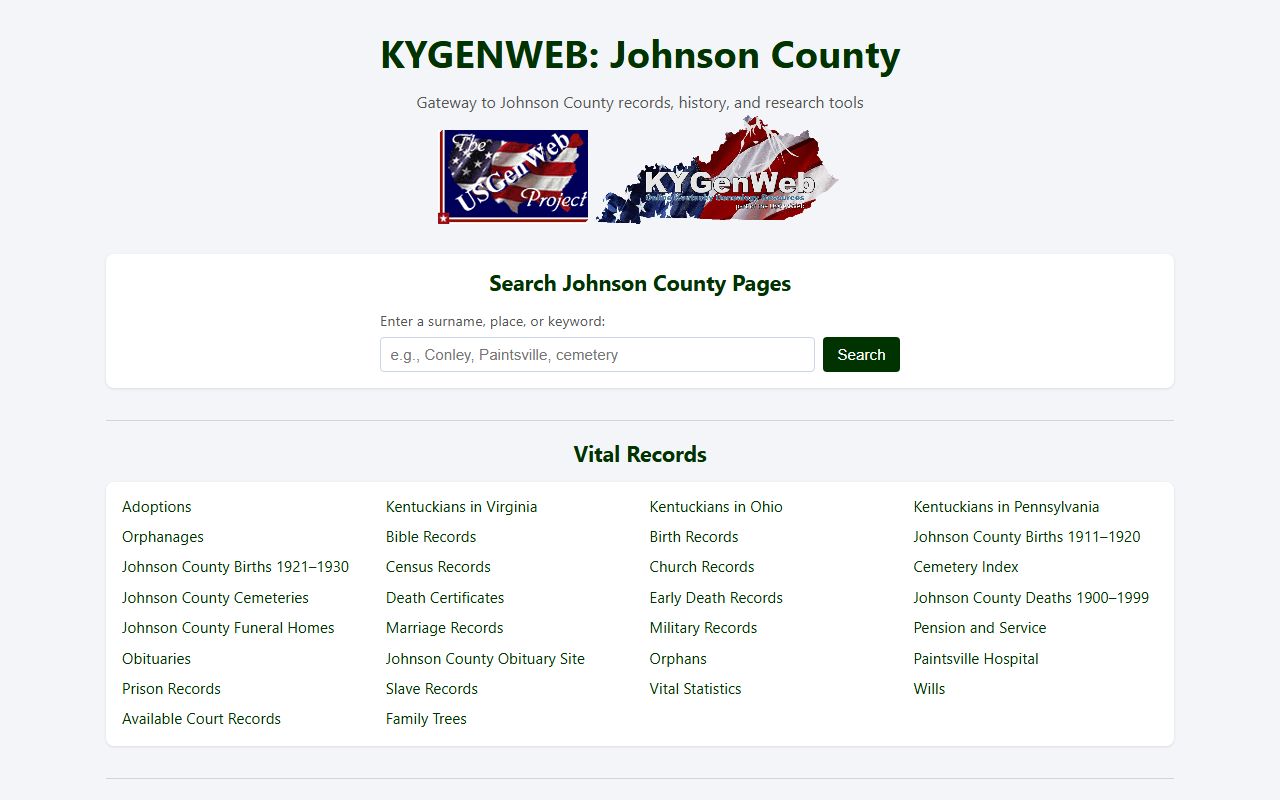
KYGenWeb Johnson County: Part of the national USGenWeb Project, this volunteer-run site provides free access to transcribed records, cemetery listings, family histories, and research guides. The Johnson County page serves as a hub for researchers seeking connections and sharing information about their Eastern Kentucky ancestors.
FamilySearch: The Church of Jesus Christ of Latter-day Saints maintains free access to Johnson County records including digitized microfilms of deeds, wills, and court records. Many records can be viewed online; others require visiting a Family History Center.
Ancestry.com: This subscription service includes Johnson County census records, military documents, and compiled family histories. The site has significant collections specific to Eastern Kentucky genealogy research.
Johnson County Historical Society: Local historical societies often maintain unique collections not found in government repositories. Contact the society for information about special collections and research assistance.
Genealogy Research Tips for Johnson County
Successful genealogy research in Johnson County requires strategy and persistence. These tips will help you navigate records efficiently and avoid common pitfalls when tracing your Appalachian heritage.
Start with parent county records. Since Johnson County formed from Floyd, Lawrence, and Morgan counties in 1843, any records before that date will be found in those parent counties. Research the geographic location of your ancestor's land to determine which parent county likely holds their earliest records.
Explore multiple record types. Relying solely on census records or vital statistics limits your research. Land deeds, court cases, and probate files often contain relationship details absent from other sources. Each record type illuminates different aspects of ancestral lives in the mountains.
Consider geographic challenges. The mountainous terrain of Johnson County meant that families often stayed in the same area for generations, but travel between communities was difficult. Your ancestors may have conducted business, married, or attended church in neighboring counties. Expand your search to include Floyd, Lawrence, Morgan, Martin, and Knott counties.
Connect with other researchers. Eastern Kentucky genealogy groups on social media and message boards connect you with distant cousins researching the same lines. Johnson County families often have extensive kinship networks, and connecting with other researchers can break through brick walls.
Nearby Counties for Genealogy Research
Ancestors rarely remained within a single county boundary in eastern Kentucky. Families moved between mountain hollows, married neighbors from adjacent counties, and conducted business across county lines. When Johnson County records fail to reveal the answers you seek, check these neighboring counties.
Floyd, Lawrence, and Morgan counties deserve special attention from Johnson County researchers as the parent counties. These counties hold all records for the area prior to 1843. Early settlers appear in deed books, marriage registers, and court minutes from these jurisdictions.